
Chilled and Frozen Food Packaging: Product Packing vs Thermal Shipping
Separate primary food packaging from thermal shipping packaging, and see where the equipment boundary sits between product packing and cold chain packout.
The comparison problem: two packaging jobs under one name
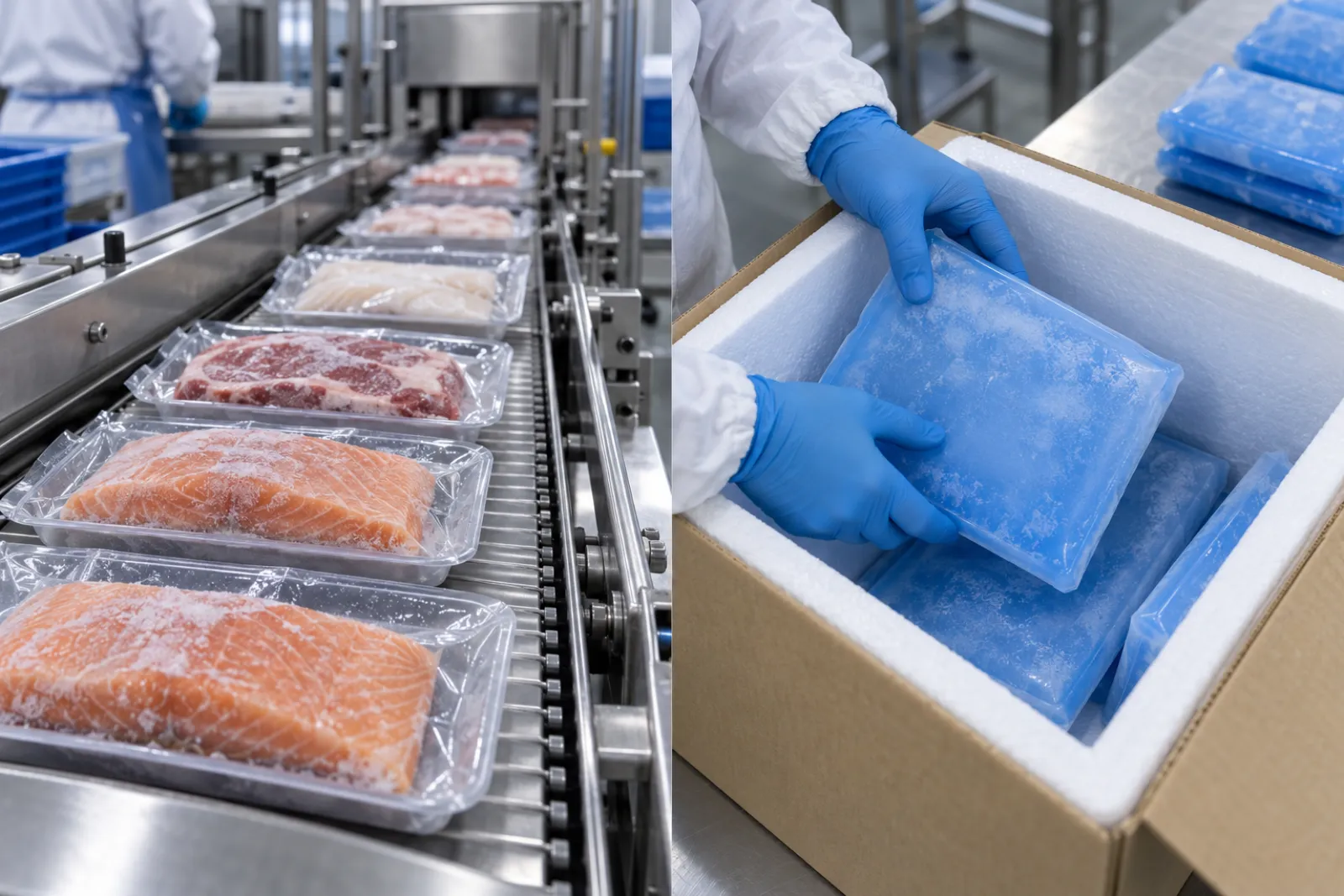
“Food packaging” covers two different jobs that are often bought, specified and audited separately. The first is product packing: portioning the food, putting it in a tray, pouch or case, and sealing it so it stays safe and presentable. The second is thermal shipping: placing that finished, packed product into an insulated box with a refrigerant so it stays cold through a delivery. Mixing them up leads to wrong equipment purchases, wrong documents requested from suppliers, and requirements copied from the wrong industry.
This guide compares the two jobs, shows where the equipment boundary sits, and explains why pharmaceutical requirements should not be reused for food, or the reverse. It belongs to the Applications section, which covers how packout ideas apply in specific product settings.
Scope note: This guide does not state food safety limits, holding temperatures or shelf-life conclusions. Those come from your food safety plan, your regulator and the product’s own specification. Rules differ by country and by food type, so confirm which ones apply to you.
Common premises
Both jobs start from the same facts. The food is already identified and already inside its own packaging, and the goal downstream is to keep it within the conditions your food safety system requires until it reaches the customer. Hygiene, traceability and labeling matter in both. What differs is the point in the process, the controlling document and the kind of equipment.
What each job controls
Product packing happens inside the food business’s process line. It decides what touches the food, how portions are formed, whether air is removed or replaced with a protective gas, and how the unit is coded. The controlling documents are the food safety plan, the product specification and the rules on materials that contact food. Equipment includes portioning, tray sealing, vacuum or modified atmosphere machines, freezers or chillers, and case packing.
Thermal shipping begins when the finished product goes into a shipment. It decides the insulated box, the amount and format of refrigerant, how the box is closed, and what label and records go with it. The controlling documents are the shipping specification, the carrier’s rules and the customer’s receiving requirements. Equipment includes box erectors, refrigerant filling and conditioning, liners, closing and labeling stations.
Food-grade materials matter in both, in different ways. Primary packaging touches the food directly and needs materials suitable for food contact. In thermal shipping, the refrigerant and liner normally sit outside the food’s primary pack, but you should still confirm with your food safety team how contact, leakage and cleanliness are controlled.
Where the equipment boundary sits
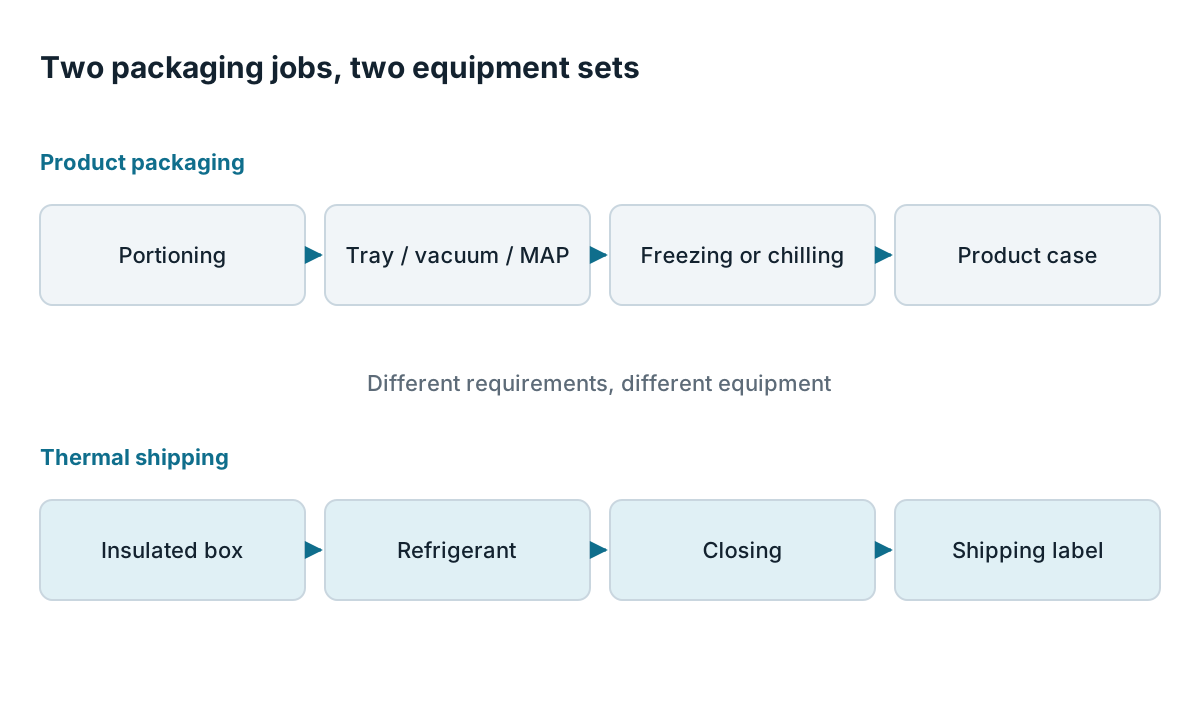
The handoff usually occurs at the product case or the finished sealed unit. Upstream of that point the equipment is part of food production. Downstream, it is shipment preparation. Some businesses sit on both sides, for example meal-kit and direct-to-consumer operations that pack and ship from one site. They still need two sets of requirements, because a tray sealer and a refrigerant station fail in different ways and are checked by different people.
Equipment that spans the boundary needs particular attention. End-of-line packout equipment takes finished cases or units and prepares them for shipping, so its requirements must say clearly where product handling ends and thermal packing begins.
Side-by-side comparison
| Question | Product packing | Thermal shipping |
|---|---|---|
| What is it protecting? | Food safety, integrity and presentation of each unit | Product condition during transit and handover |
| Typical owner | Production and food safety team | Logistics, shipping or fulfillment team |
| Governing documents | Food safety plan, product specification, food contact rules | Shipping specification, carrier rules, customer requirements |
| Typical equipment | Portioning, sealing, vacuum or modified atmosphere, freezing or chilling | Boxes, liners, refrigerant, closing and labeling |
| Hygiene focus | Food contact surfaces and product zones | Cleanliness of the packing area, liners and refrigerant handling |
| Records | Batch, line and code records | Shipment, refrigerant, box and temperature records |
| Failure mode | Seal defects, contamination, wrong code | Warm product on arrival, leaking refrigerant, wrong label |
Why pharma requirements should not be reused for food
Pharmaceutical shipments follow qualified configurations, product-specific conditions set by the product owner and a quality unit with release authority. Food shipments are governed by food safety systems and by transport rules for perishable food, which differ in purpose and in evidence. Copying a pharmaceutical specification into a food request for quotation tends to add qualification documents the food business does not need and to leave out the food-specific points the supplier should address, such as hygienic design and food contact materials. The same warning applies in reverse: a food-grade packing line is not evidence of a qualified pharmaceutical shipper.
Three named references show how different the contexts are. The Codex code of practice for quick frozen foods addresses handling of that food category along the chain. The ATP agreement addresses transport equipment for perishable foodstuffs in the countries that adhere to it. In the United States, the sanitary transportation rule for human and animal food sets responsibilities for shippers, loaders, carriers and receivers. None of these is a pharmaceutical guide, and none should be used as one. Check the current versions and confirm which apply to your operation.
Temperature monitoring in food shipping
Food distribution has its own standards for recorders. EN 12830 covers temperature recorders for the transport, storage and distribution of chilled, frozen and deep-frozen food. Whether a given parcel shipment needs a recorder at all depends on your customer agreements, your food safety plan and the regulations you operate under. For small-parcel chilled and frozen shipments, businesses often sample by lane or period instead of logging every box. Decide that with your food safety team and document the logic.
Choosing the shipping side: box and refrigerant
Once the boundary is defined, the shipping side follows its own selection path. Start with transit time, ambient exposure and the condition your product specification requires on arrival. Our guides on insulated shipper selection and refrigerant selection cover how to set those inputs. For frozen product, ask whether the refrigerant is meant to hold the product frozen or only to slow warming. For chilled product, ask whether freezing damages quality, because that affects how refrigerant touches or sits near the pack.
Illustrative example: a business packs frozen portions in vacuum trays and ships them in insulated boxes with frozen gel packs. It might define two documents. The first covers product packing: tray, seal, code and case. The second covers shipping packout: box size per order size, refrigerant quantity per box size, closing method and label. Each document has its own owner and its own change control. No number from either document applies to the other.
Typical mistakes at the boundary
Three mistakes recur. First, a buyer asks a thermal packaging supplier for food contact certificates that belong to the primary pack, or asks a product packing supplier to guarantee transit performance. Each supplier can only speak to its own scope. Second, the shipping specification is copied from an earlier product with a different density or pack format, so the refrigerant quantity no longer fits. Third, nobody owns the handoff, and cases leave the freezer and wait on a warm dock before packout begins. Naming the boundary and the person responsible for it addresses all three.
Dispatch and handover
A shipment is only as controlled as its handover. Cut-off times, staging temperature, carrier collection and responsibility for any logged data need clear owners. Our warehouse handover checklist lays out those checks for temperature-sensitive dispatch.
Questions for suppliers
- Does the equipment touch food contact surfaces, and if so, what cleaning and hygienic design documentation do you provide?
- Where does your scope of supply start and stop relative to the product line?
- How is a change in box size or refrigerant quantity handled at the station?
- What records does the equipment keep, and can the food safety team review them?
Checklist for separating the two jobs
- Product packing and thermal shipping requirements are written as separate documents.
- The handoff point between them is named, for example the sealed unit or the product case.
- Owners are assigned for each job, including food safety review.
- Food contact materials are confirmed for primary packaging only where applicable.
- Shipping specification states the condition required on arrival, taken from the product specification.
- Applicable food and transport rules are identified and checked at their current version.
- No pharmaceutical qualification requirement has been copied without a stated reason.
- Monitoring approach, such as per-box or sampled, is agreed with food safety.
Limitations of this guide
This guide is general information. It gives no temperature limits, shelf-life judgments or legal advice, and it cannot tell you which food safety or transport rules apply to your business. Standards and regulations change, so check the current version and consult your food safety lead or regulator. Cold Chain Practice has not tested any packaging or equipment discussed here.
Related guides
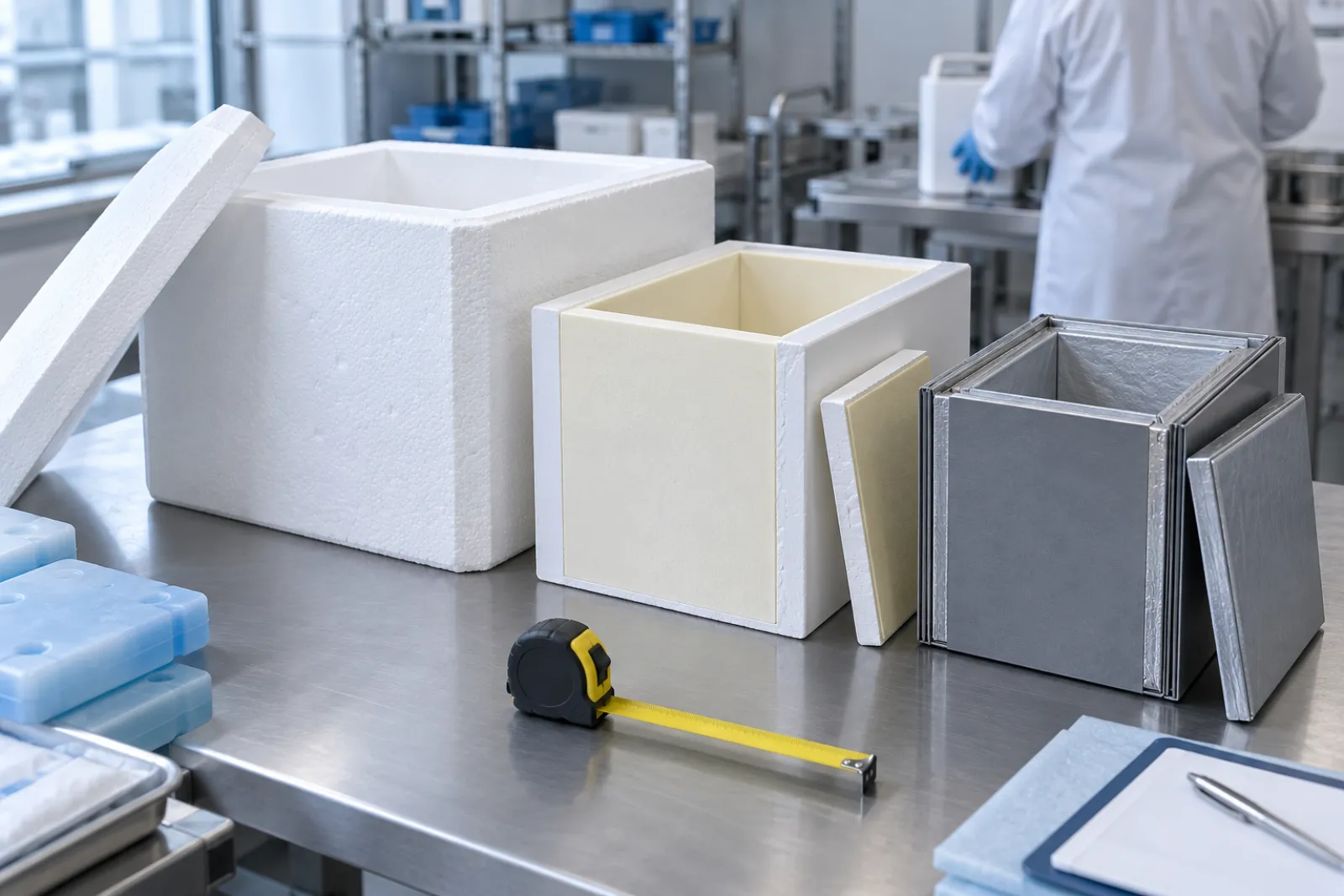
Selecting Insulated Shippers: Payload, Transit Time and Handling Constraints
Turn payload, transit time, ambient conditions, dimensions and handling into clear purchasing inputs for insulated shipper selection and supplier quotes.
Read guide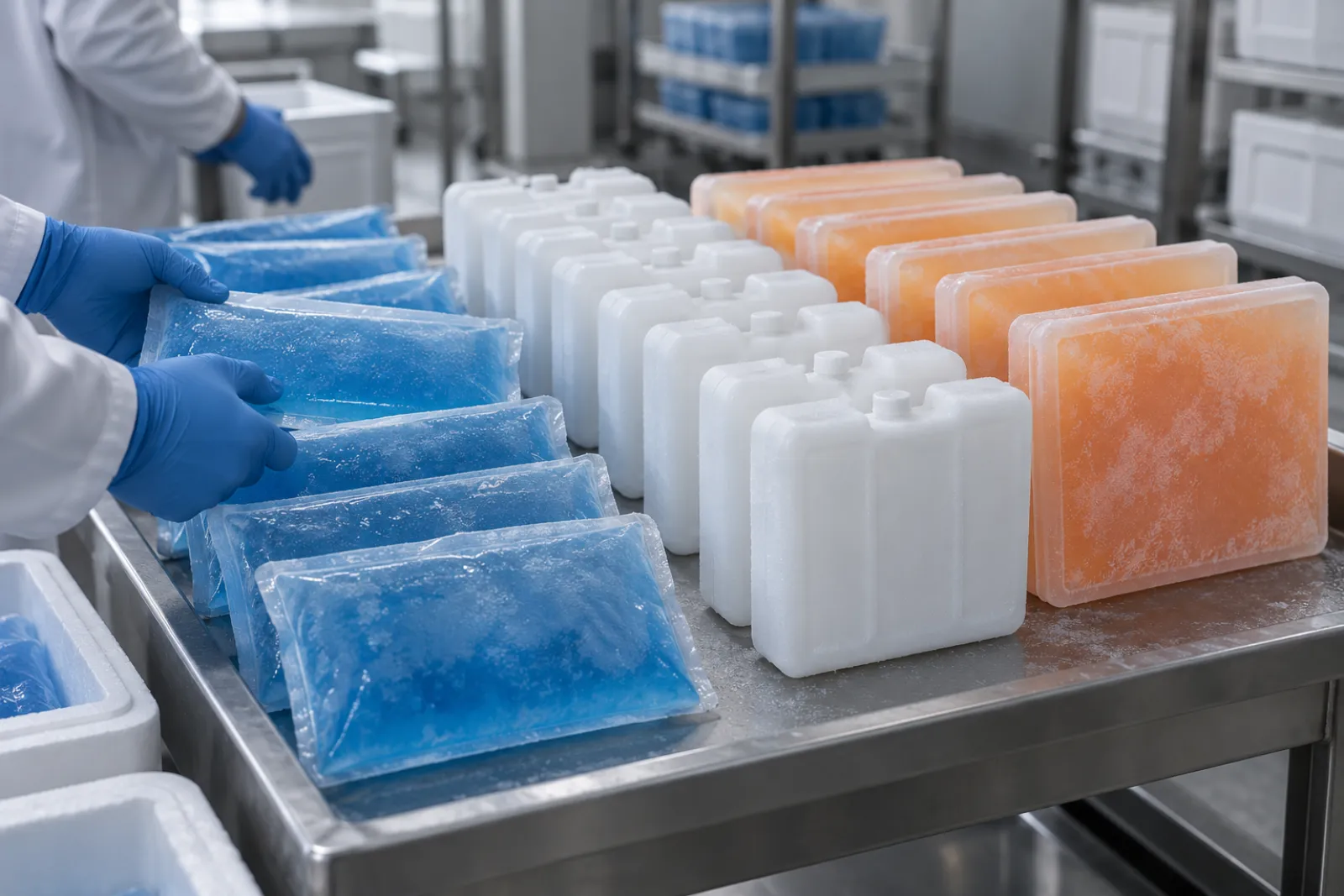
Comparing Water-Based Gel Packs and Other PCM Refrigerants
Compare cold chain refrigerants by formulation, phase-change range, conditioning and encapsulation instead of relying on a simple gel versus PCM label.
Read guide
Cartoning, Case Packing and Case Sealing in a Cold Chain Packout Line
How retail cartoning, shipping case packing, case sealing and insulated packaging steps differ in a cold chain line, and what to check at each interface.
Read guide
Temperature-Sensitive Dispatch: A Warehouse Handover Checklist
A cold chain dispatch checklist covering pick checks, logger start, documents, carrier handover, data responsibility and exception escalation fields.
Read guide