
Cold Chain Equipment Procurement: A Practical RFQ Checklist
Turn capacity, environment, interfaces, evidence, service and acceptance needs into a clear RFQ, with a copy-ready field table for packout equipment buyers.

What this checklist is for
Most disputes over packaging and packout equipment trace back to a request for quotation that left something open. The supplier assumed a lower speed, a different carton, a clean power supply or a basic manual. The buyer assumed the opposite. Both were reasonable, and neither was written down.
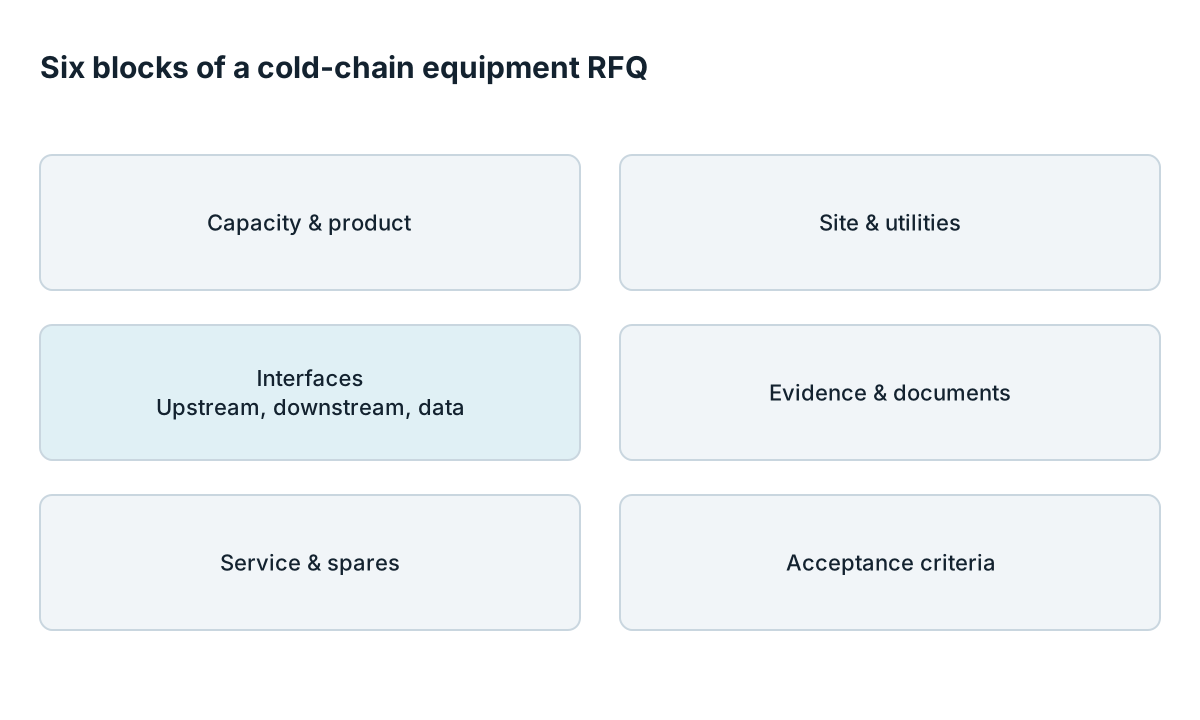
This guide helps you turn your requirements into an RFQ that suppliers can price on the same basis. It covers six blocks: capacity and product, site and utilities, interfaces, evidence and documents, service and spares, and acceptance. The aim is quotes you can compare line by line. Other guides in the procurement section go deeper on acceptance testing, report review and cost.
Scope note: This guide describes how to structure an RFQ. It does not recommend equipment types, brands or models, and it does not set regulatory requirements for your site. Your quality system, your legal counsel and the current versions of applicable standards decide those.
Define the inputs before you write a single question
An RFQ is only as precise as the internal work behind it. Before you send it out, agree the following with operations, quality, engineering and maintenance.
- The job to be done: describe the task in one sentence, such as “close and label insulated shippers at a packing bench”. Equipment named in the first line of an RFQ tends to lock out better-fitting alternatives.
- Product and pack variants: list every carton, shipper, liner and refrigerant format the machine must handle, including the ones you only run a few times a year.
- Throughput as a range: state normal, peak and minimum volumes per shift, and the number of shifts. Suppliers size equipment to the number you give them, so a peak that appears only in an email later becomes a change order.
- Environment: room temperature range, humidity, cold room or ambient, washdown or dry, cleanroom class if any.
- Who operates and maintains it: operator training level, shift handover, and whether your maintenance team can service the machine or you depend on the supplier.
- Governing documents: which internal procedures, validation approach and external standards apply.
If a variable is unknown, write “to be confirmed by [date]” in the RFQ rather than leaving it out. Suppliers will price an assumption either way, and you want to see which one.
Copy-ready RFQ field table
Use this as a starting point and delete rows that do not apply. The right-hand column describes what a usable answer contains. It gives no values to copy.
| Block | Field | What to specify or request |
|---|---|---|
| Capacity and product | Throughput | Required units per hour as a range, plus shifts per day and operating days |
| Capacity and product | Pack formats | Dimensions, weight range and material of every carton, shipper and insert |
| Capacity and product | Changeover | Number of formats, who performs changeover, target changeover method (tool-free or tooled) |
| Site and utilities | Footprint and access | Floor area, ceiling height, door and lift dimensions, floor loading |
| Site and utilities | Utilities | Voltage and phase, compressed air quality, network ports, cooling or heating needs |
| Site and utilities | Ambient conditions | Temperature and humidity range at the installation point |
| Interfaces | Upstream and downstream | What feeds the machine and what takes product away, including conveyor heights and handover method |
| Interfaces | Data and control | Barcode or label data source, line controller connection, alarm and status signals, data export format |
| Interfaces | Operator interface | Language, access levels, audit trail needs, how recipes are stored |
| Evidence and documents | Technical file | Drawings, electrical diagrams, parts lists, manuals in the working language |
| Evidence and documents | Conformity and safety | Declaration of conformity and risk assessment records for the applicable jurisdiction |
| Evidence and documents | Verification | Test protocols, calibration records for critical instruments, software documentation if relevant |
| Service and spares | Response | Support hours, remote access terms, on-site response commitment in writing |
| Service and spares | Spares | Recommended spares list with lead times, and which parts are proprietary |
| Service and spares | Training | Operator and maintenance training scope and language |
| Acceptance | FAT and SAT | Test cases, samples, pass criteria and who witnesses |
| Acceptance | Payment tied to acceptance | Milestones and the portion held until site acceptance |
| Acceptance | Warranty | Start date, duration, exclusions and what counts as consumable |
For machines that move product and for any equipment with software, ask the supplier how they approach machine risk assessment and software verification. ISO 12100 describes risk assessment for machinery, and in the EU the Machinery Regulation sets conformity requirements. GAMP 5 and ASTM E2500 describe risk-based approaches to specifying and verifying equipment and computerized systems in regulated settings. Check the current version of each before citing it in a contract.
Where the six blocks sit in the RFQ
The diagram shows the six blocks as one package. Treat them as a unit. A quote that answers only the first block prices a machine and says nothing about a working installation.
Interfaces: the block most RFQs leave thin
Interfaces cause more late surprises than the machine itself. Cover three kinds.
Physical interfaces: conveyor heights, product orientation, reject handling and how operators reach the machine for clearing jams. If you plan a bench or a cell, the guide on packout stations lists the layout questions to settle first.
Data: decide where label content, lot numbers and order data come from, and what the machine sends back. If the equipment writes or reads monitoring data, align the format with your logger choice. The guide on data logger selection covers what to fix on the monitoring side so the two specifications do not conflict.
Organizational: name who owns the machine after handover: production, engineering or quality. An unowned machine goes without preventive maintenance and calibration.
How to compare the quotes you get back
Quotes rarely arrive in the same format. Normalize them before you compare prices.
| Comparison item | What to check | Typical failure mode |
|---|---|---|
| Scope | Is every row of your field table answered, excluded or marked optional? | Silent exclusions that reappear as extras |
| Throughput basis | Is the quoted speed for your formats and your operators, or a best case on a standard carton? | Nameplate speed that is not reachable in your setup |
| Documents | Which documents are included in the price and in what language? | Documentation sold separately at the end |
| Acceptance | Are FAT and SAT included, and who bears retest cost? | Retests charged as variations |
| Service | Is response time a commitment or a target? | A “target” that carries no remedy |
| Spares and consumables | Are proprietary parts identified? | Price advantage lost to captive spares |
| Lifecycle | What does the quote say about software updates and obsolescence? | Unsupported controllers after a few years |
Score the answers against your priorities and keep the scoring sheet. When an award is challenged internally, a dated scoring sheet is better evidence than memory. For the cost side of the comparison, the worksheet in packout cost shows how to put materials, labor, monitoring and losses next to the equipment price.
Evidence to ask for, and how to read it
Ask for evidence when you request the quote, before the purchase order. Look for three things.
- Specificity: a test summary that names the machine configuration, formats and settings is more useful than a brochure statement about performance.
- Relevance: evidence for a different product, speed or environment shows what the supplier can do in general and says little about what they will deliver for you.
- Traceability: documents should carry identifiers, dates and revision status, and be signed by a named function.
Plan the acceptance tests while you write the RFQ. The guide on FAT and SAT evidence lists the items buyer and seller should agree in advance. If you will rely on supplier reports for packaging performance, read them with the method in the guide on qualification report review.
Contract points to settle before the purchase order
These items cost little to agree early and a lot to argue later.
- The RFQ and the supplier’s answers form part of the contract, in a stated order of precedence.
- Acceptance criteria are attached as a schedule instead of being referenced by a phrase.
- Payment milestones are tied to FAT, delivery and SAT, with a retained portion until SAT passes.
- Changes to the machine, software or documents after FAT follow a written change procedure.
- Delivery date, delay remedies, and what happens if the site is not ready.
- Warranty starts on the SAT date or the date of first production use, never on the shipping date.
- Ownership of recipes, configuration files and source documents.
- Confidentiality of your product and pack details.
Pre-send checklist
- The job to be done is described in one sentence, without naming a machine type.
- Throughput is given as a range with shifts and operating days.
- Every pack format and changeover is listed.
- Site conditions, utilities and access are documented.
- Upstream, downstream and data interfaces are described, with an owner for each.
- Required documents and evidence are listed, with language.
- Standards and procedures that apply are named, with a note to confirm current versions.
- FAT and SAT expectations and payment milestones are attached.
- Service response, spares and training are requested in writing.
- A scoring sheet exists before quotes arrive.
Limitations of this guide
This guide gives you a structure for asking questions. It is not a specification for any machine, and it does not give throughput figures, price ranges or lead times, because those depend on your formats, site and market. The field table is generic: regulated products, food contact, hazardous areas and export markets each add requirements it does not cover. Standards are named for context only. Read the current edition, and ask your quality, safety and legal functions how they apply to your purchase.
Related guides

How to Specify a Cold Chain Temperature Data Logger
A specification checklist for a cold chain temperature data logger: range, accuracy, logging interval, export method and calibration documents to request.
Read guide
Designing a Cold Chain Packout Station: Process and Equipment Checklist
A practical checklist for designing a cold chain packout station: workstation layout, refrigerant staging, records, interfaces and what to confirm before buying.
Read guide
FAT and SAT: Evidence to Agree Before Equipment Purchase
A buyer's checklist of FAT and SAT items to agree with the seller before purchase: protocols, test cases, deviations, sign-off and documents for packaging equipment.
Read guide
Cold Chain Packout Cost: A Transparent Comparison Worksheet
A transparent cost worksheet for cold chain packout: materials, labor, monitoring, return logistics and losses, with formulas and blank cells you fill in.
Read guide