
Thermal Packaging Qualification Reports: Reading Conditions and Limitations
How to read a thermal packaging qualification report: check the test object, payload, temperature profile, duration, acceptance criteria and stated limits.
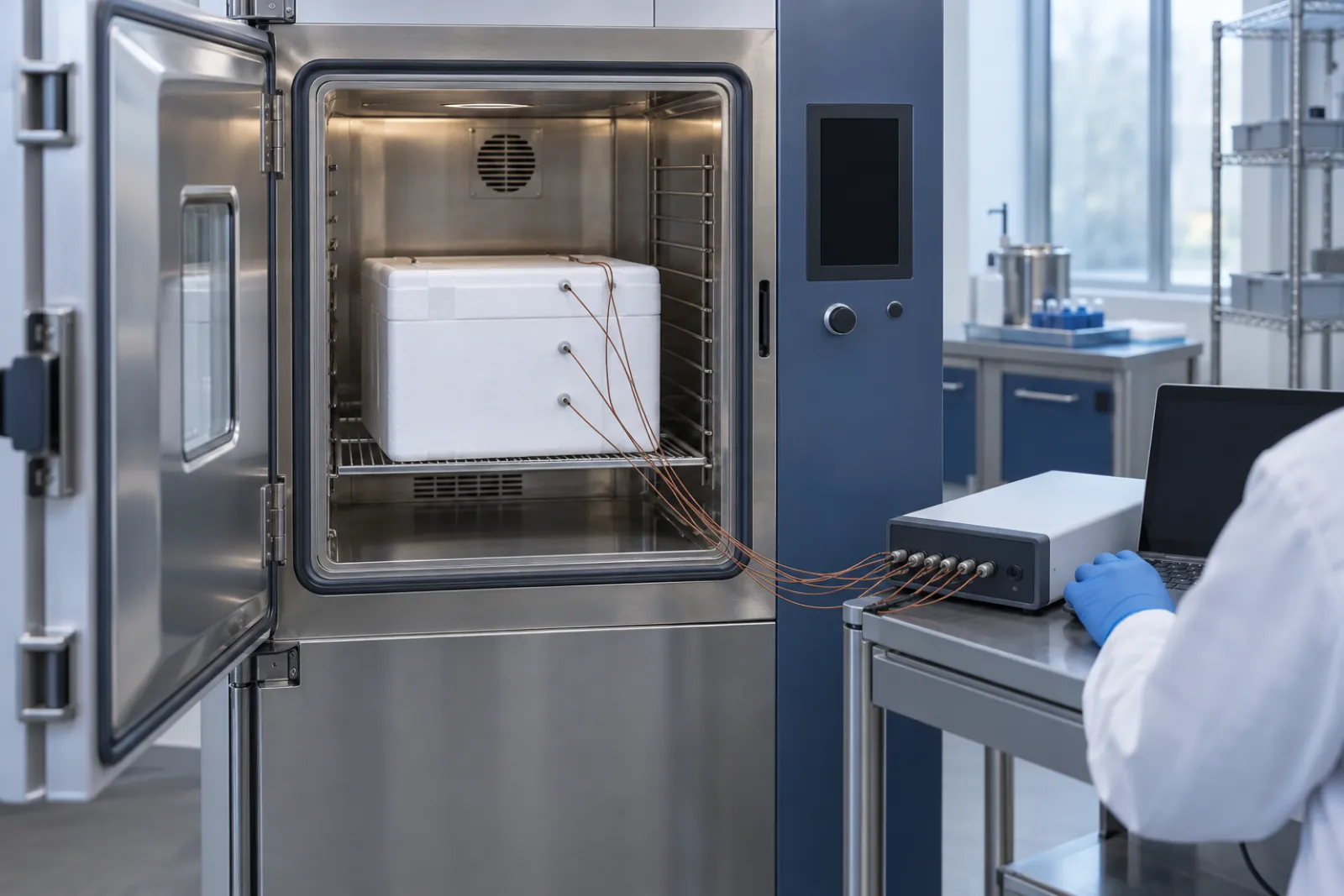
What a qualification report can and cannot tell you
A supplier hands you a qualification report and says the shipper is “qualified”. That word hides a lot. A report documents what was tested, under which conditions, against which criteria. It does not describe what will happen on your lane with your product. Reading one well means finding the point where its conditions end and yours begin.
This guide gives a method for reviewing thermal packaging qualification reports before you rely on them. The procurement section has companion guides on specifying and accepting equipment.
Scope note: This guide helps you read a report. It does not tell you whether a packaging configuration is suitable for any medicine or food, and it does not give acceptance limits. Product temperature ranges come from the product documentation, and release decisions belong to your quality system.
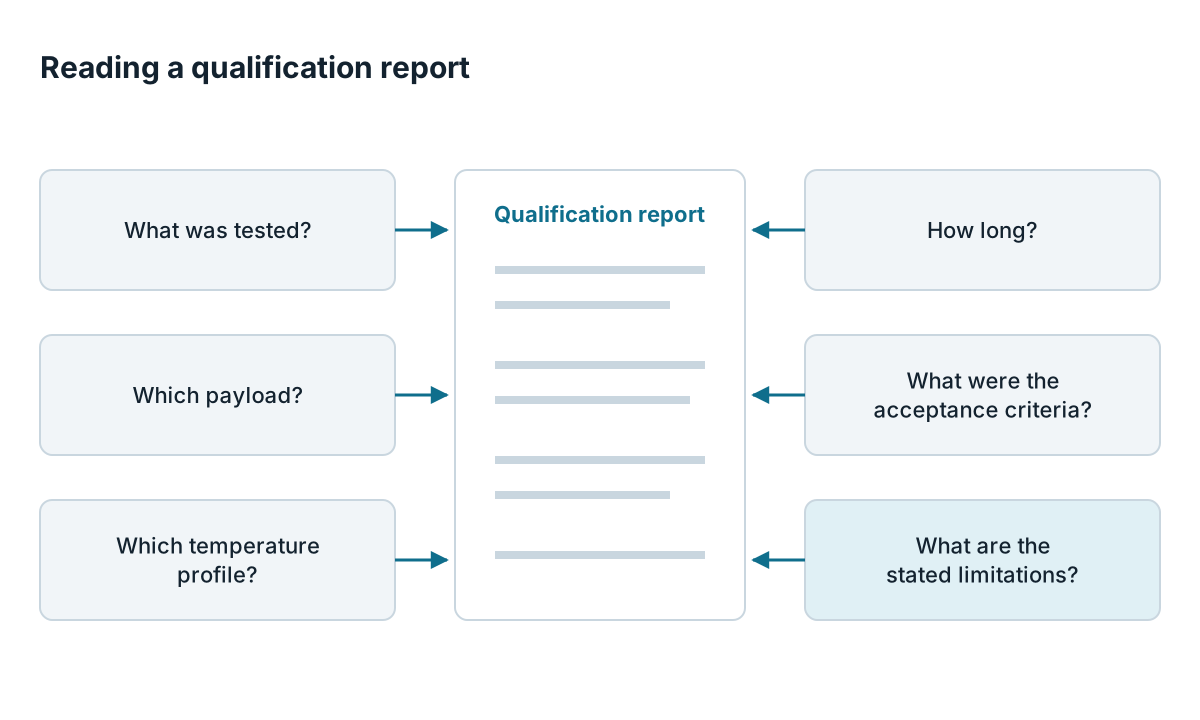
The six questions to ask of every report
The diagram shows the six questions as a reading frame. Work through them in order, and write the answers beside the report reference in your supplier file.
1. What was tested?
Identify the exact test object: shipper model and size, insulation material and thickness, lid and seal method, liner, refrigerant type and conditioning, and any inner or outer carton. Compare it with what you will buy. A report for one size does not automatically cover a smaller or larger one, since thermal behavior changes with volume and wall area. Check revision identifiers and dates: a design change after the test may void the link between the report and the current product.
For active systems, the object includes the temperature control unit, software version, power source and any battery. The PDA technical report on active systems describes qualification considerations for this type. Read the current edition.
2. Which payload?
Look for payload mass, thermal mass and arrangement. Water bottles, dummy product, real product and an empty box behave differently. Ask:
- Was the box loaded to its maximum, minimum or both?
- Was the payload pre-conditioned to the same temperature you will pack at?
- Where were the sensors placed: core, corners, near the refrigerant, near the lid?
A report that tested only a full load says little about a half-loaded shipment, which often has more air space and behaves differently.
3. Which temperature profile?
The test chamber follows a profile that represents some ambient conditions. Find it. Check the high and low plateaus, the ramp rates, and whether the profile was a standard one from a test procedure or one designed by the supplier. ISTA 7D and 7E are published thermal transport test procedures, and the ISTA 20 Series covers design qualification of insulated transport packaging. Report cover pages often name them. If a report claims alignment with a standard, check which version and whether any step was changed. Ask whether the profile is a summer or winter case, and how it compares with the conditions on your lanes.
4. How long?
Find the test duration and what it counts: time from closing the box to the first sensor leaving the range, or time to a fixed end point. Check whether hold time was calculated from the first reading, an averaged reading or the worst sensor. Then subtract the time your own process will take before and after transit, such as packout time, dock waiting and customer receiving. Hold time in a report is a measured period under stated conditions, so a claim of “valid for X hours” only holds under those conditions.
5. What were the acceptance criteria?
Look for the criterion stated before the test, with its numerical limits and the rule for applying them (all sensors, mean of sensors, excursions allowed or not). If the criterion appears only in the results section, ask whether it was in the protocol. Check that the range used matches your product’s documented range. A report built around one range does not help if your product has another.
6. What are the stated limitations?
A good report says what it does not cover: sizes, lane types, seasons, handling, number of reuse cycles and shipment orientation. If the report has no limitations section, treat that as a gap and ask the supplier to state their scope in writing.
Supporting evidence to ask for next to the report
| Item | Why it matters | What to look for |
|---|---|---|
| Protocol | Shows criteria were set before testing | Approved and dated before the test |
| Raw data | Lets you check the summary | Sensor-level data, not only averages |
| Instrument calibration | Backs the temperature readings | Current certificates, traceable calibration; see calibration certificates |
| Test laboratory | Competence of the party who ran the test | Statement of the laboratory’s competence framework, such as ISO/IEC 17025, checked against its current edition |
| Packing instruction | Shows how the tested box was assembled | Layout, refrigerant count and conditioning steps |
| Deviation record | Shows what went wrong during testing | Listed deviations and their impact assessment |
Comparing a report with your own conditions
Make a short gap table. In column one, list each point from the report. In column two, list your own value. In column three, mark it “covered”, “partly covered” or “not covered”. Anything not covered becomes either a request to the supplier or a risk for your own qualification work.
| Report point | Common gap | How to handle it |
|---|---|---|
| Shipper size | You use a different size | Ask whether a bracketing rationale exists, or plan your own testing |
| Payload | Your product has different thermal mass | Ask for results with a lighter or heavier payload |
| Temperature profile | Your lanes are hotter, colder or longer | Compare ambient ranges and consider a supplementary test |
| Duration | Real transit includes delays | Define a margin policy in your quality system |
| Packout method | Your staff pack differently | Fix the packing instruction and train to it |
| Reuse | You plan multiple cycles | Ask for reuse evidence and inspection criteria |
For choice between formats, the comparison in active vs passive packaging frames what each type depends on, and the guide on insulated shipper selection covers how construction affects thermal performance. If you work in the pharmaceutical sector, see pharmaceutical packout for how packaging evidence connects to packout steps.
Common failure modes in report use
- Using a report as a general certificate: the report is bound to its conditions. Moving outside them needs a rationale or new testing.
- Mixing up design qualification and operational qualification: design testing in a chamber shows capability under set profiles. It does not replace checking real lanes and handling.
- Ignoring the packing instruction: a tested box packed differently is a different box.
- Relying on a summary page: summaries leave out sensor positions and deviations.
- Treating hold time as a guarantee: it is an observed period in a test and does not predict the outcome of a particular shipment.
- Stale reports: materials, suppliers and designs change. Ask for a change notification commitment.
Review checklist
- Test object matches the product and size you will buy, with revision identifiers.
- Payload mass, arrangement and sensor positions are stated and relevant.
- Temperature profile is documented and compared with your lanes.
- Duration and its start and end points are clear.
- Acceptance criteria were set in an approved protocol before testing.
- Criteria match your product’s documented range.
- Stated limitations are listed, or the supplier has given them in writing.
- Raw data, calibration records and packing instruction are on file.
- A gap table records what is covered and what is not.
- A change notification arrangement exists with the supplier.
Limitations of this guide
This guide offers a reading method. It cannot approve a packaging system, and it does not replace your qualification plan or regulatory obligations. Standards and technical reports are named for context only: check the current versions, and consult your quality function on how much reliance on supplier reports is acceptable for your products.
Related guides
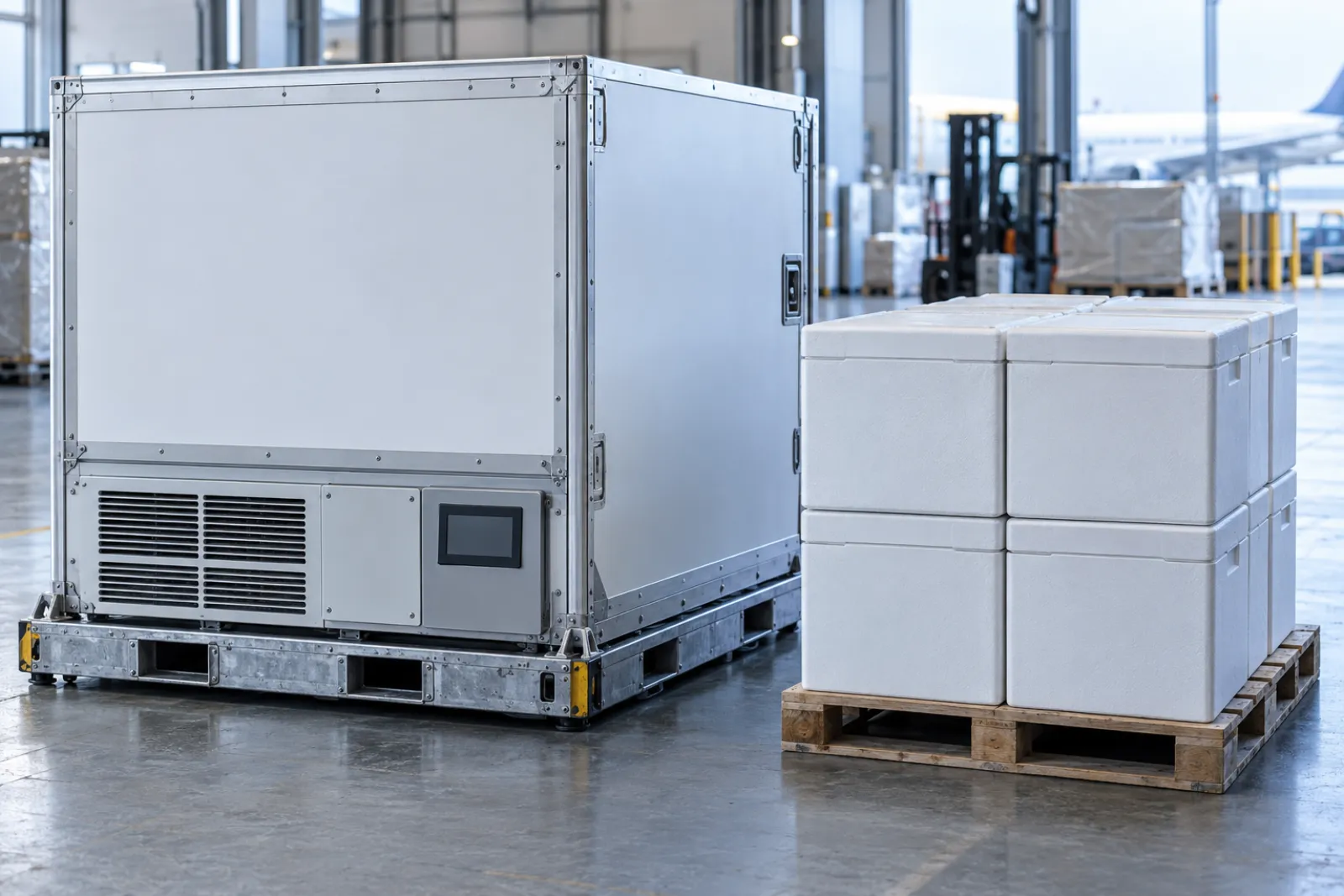
Active vs Passive Cold Chain Packaging: A Buyer's Comparison
Compare active and passive cold chain packaging by system boundary, route constraints and operating conditions, without a universal winner.
Read guide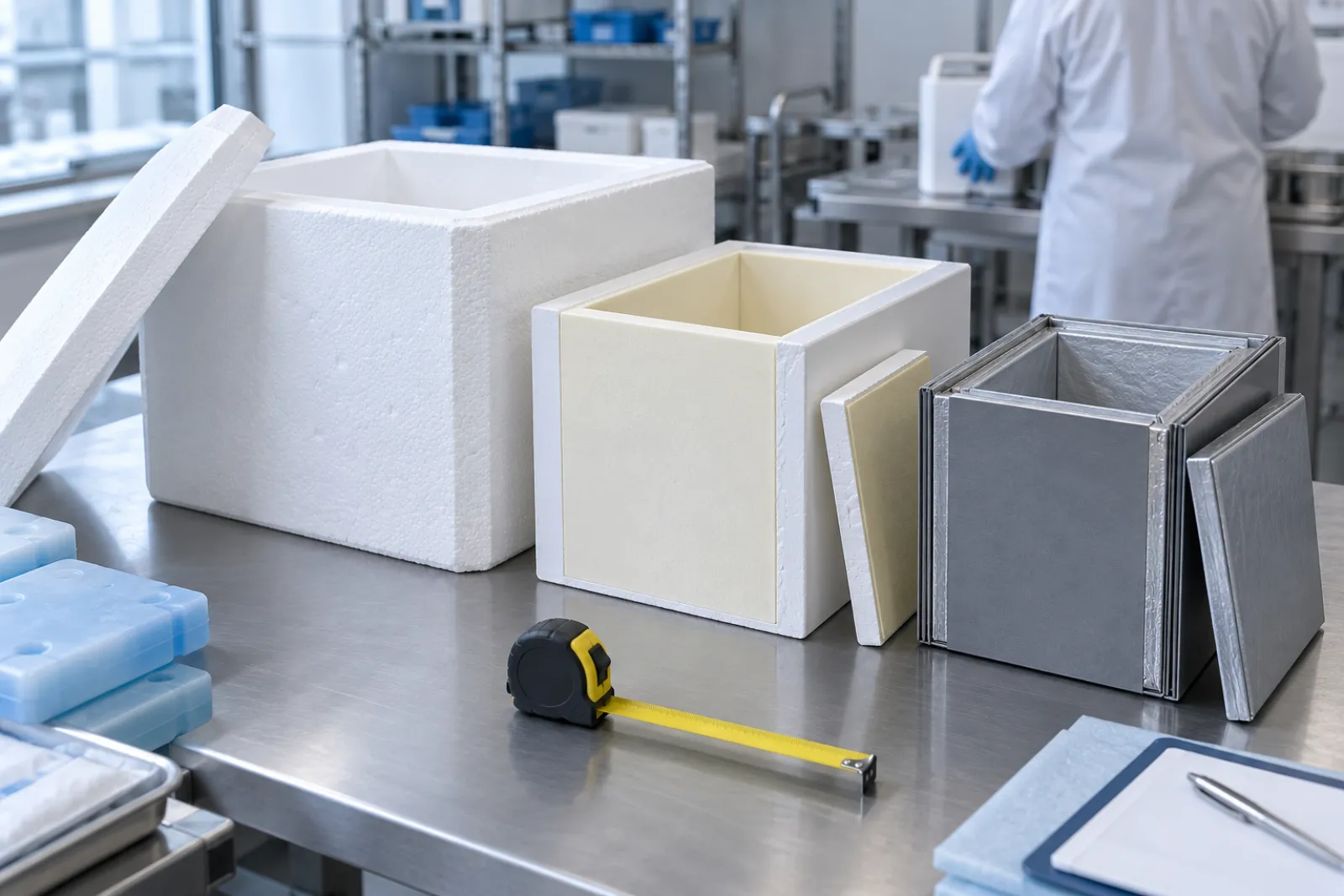
Selecting Insulated Shippers: Payload, Transit Time and Handling Constraints
Turn payload, transit time, ambient conditions, dimensions and handling into clear purchasing inputs for insulated shipper selection and supplier quotes.
Read guide
What a Temperature Sensor Calibration Certificate Should Tell You
Check a temperature sensor calibration certificate for device identity, range, dates, reference traceability and results before you accept a logger.
Read guide
Pharmaceutical Shipping Packout: What Buyers Must Define Before Equipment Selection
Build packout requirements from product documentation, lane assessment and quality input before you shortlist equipment. Owners, interfaces and records.
Read guide