
13th Annual Cold Chain Global Forum: 2015 Programme Record
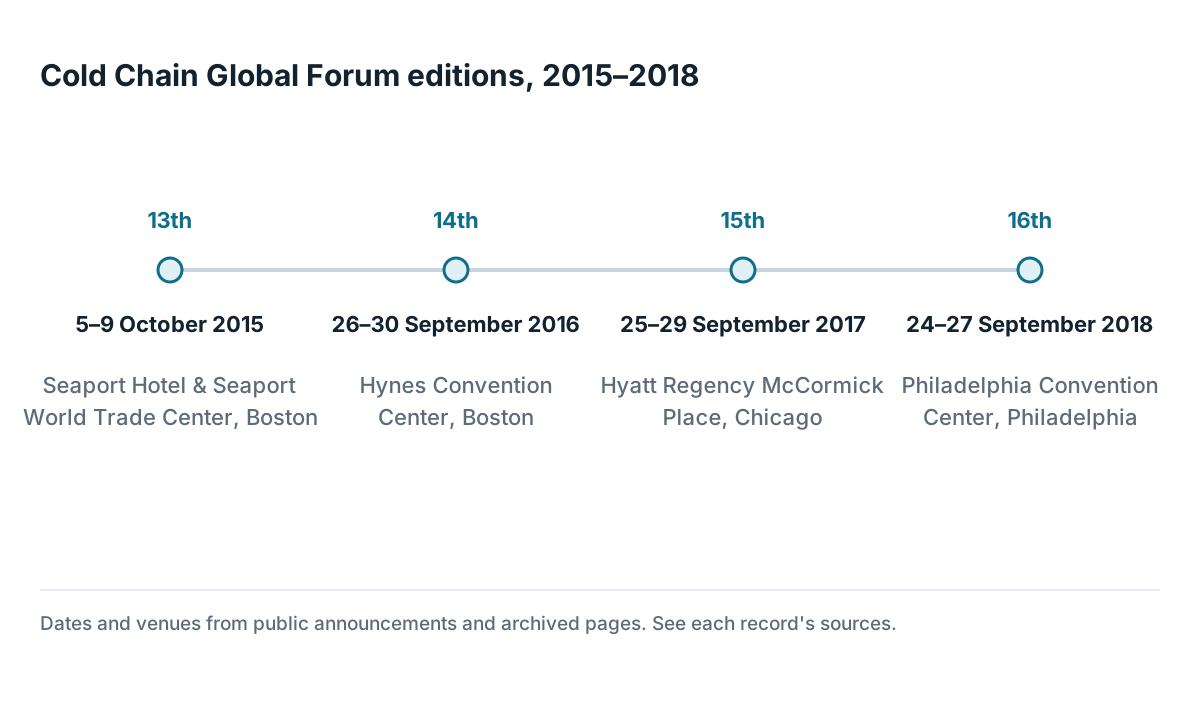
A historical record of the programme topics announced for the 13th Annual Cold Chain Global Forum, held 5–9 October 2015 in Boston, taken from the June 2015 press release.
- Historical event
- 5–9 October 2015
- Prepared by
- Cold Chain Practice Editorial Desk
- Source material
-
- 13th Cold Chain Global Forum Announces Release of Official Program, IQPC, via PR Newswire, 2015-06-09
- Short links in the 13th Cold Chain Global Forum press release, resolved by redirect, Bitly redirect headers (third party)
- Pre-Conference Workshops, Day 2 (archived /AgendaDay.aspx page, 12th Annual forum), IQPC, via Internet Archive snapshot, 2014-10-06 (snapshot date)
- Agenda (archived /Brochure.aspx page, 12th Annual forum), IQPC, via Internet Archive snapshot, 2014-04-23 (snapshot date)

In June 2015 the organizer of the Cold Chain Global Forum announced the programme for its 13th edition. This page records the topics that announcement listed. It is not a copy of the programme.
Verified facts
- IQPC named the event the “13th Annual Cold Chain GDP & Temperature Management Logistics Global Forum” and said it would return to Boston, at the Seaport Hotel & Seaport World Trade Center, on 5 to 9 October 2015. [1]
- The announcement was published on 9 June 2015. [1]
- It listed these programme topics for 2015: global GDP updates and inspection trends; cost-effective solutions for controlled room temperature and ambient products; ocean freight as an alternate mode of transportation; lane qualification versus continuous monitoring; design of stability studies and creation of a stability budget; quality risk assessment and management strategies; blending GMP, GDP and GIP into a quality management system; and supply chain security and serialization measures. [1]
- The announcement said the conference sessions would be led by speakers from regulators, associations and industry, naming among others the Dutch Healthcare Inspectorate, Eli Lilly, AbbVie, Gilead Sciences, Bristol-Myers Squibb and Genentech. [1]
- The announcement contained a link labelled as access to the programme. Today that short link redirects to an old brochure request form on the forum’s former website (the form carrying event identifier 8380). [1][2]
See the related records for the 2015 speakers and the 2015 sponsors and exhibitors.
Additional detail from the sources
- The release was issued on 9 June 2015, nearly four months before the event opened on 5 October 2015. [1]
- The release linked to more than the programme. Its sponsors and exhibitors link, home page link and recap video link resolved to separate addresses on the former site:
Sponsors.aspx,Default.aspxand aDynamicHtml.aspxpage carrying the same event identifier, 8380. [1][2] - The programme link and the speakers link in the release resolved to the same brochure request form. The release therefore pointed to one form for both purposes, and no separate programme page was found. [1][2]
- The release carried a forward-looking attendance projection, which this record does not repeat because it was a promotion, not a count. [1]
- The recap video linked from the release was not located, so nothing is recorded about the event as it took place.
Two nearby addresses that belong to 2014
Two other addresses on the former site look related to this record but belong to the 12th Annual forum. An archived /AgendaDay.aspx page for pre-conference workshops, captured in October 2014, shows 29 September to 3 October 2014. [3] An archived /Brochure.aspx agenda page, captured in April 2014, is also a 12th-edition page and shows no 2015 content. [4] Both are therefore excluded from this record. The distinction matters because the same path names were reused from year to year, and a path alone does not date a page.
Source material and scope
What exists: one press release, which gives the dates, venue and topic list, and the redirect target of its programme link.
What is missing: the programme document the link led to, the session-by-session agenda, times, and any archived copy of the brochure form. The form address was identified from the press release link, so this page can only say that the programme was offered through it. Whether the document was a PDF or a web page is unknown. No agenda times or titles are given here because none were verified. The only archived copy found of the site’s separate /Brochure.aspx address belongs to the 2014 edition, and it is not used.
How this record connects to other archive pages
This record is one of three for the 2015 edition. The 2015 speakers record shows the names that an archived page listed one month before the event, and the 2015 sponsors and exhibitors record shows the companies on a second archived page. Together they are built from the same June 2015 release and two September 2015 snapshots.
For the editions that followed, the agenda records for 2016 and 2017 show how the programme was described a year later, and the 2018 edition record closes the series covered here. The public documents behind each record are listed in the historical resource index, and the archive home links to every record.
Editorial analysis: why these topics still matter
This analysis is the Editorial Desk’s own. The announcement listed topic headings only, so nothing here describes what any session concluded or how any topic was taught.
The heading “Lane qualification vs. continuous monitoring” sets up a question that buyers still ask. Qualifying a lane tests whether a packaging system and route hold a range under a defined profile, and continuous monitoring watches each shipment as it moves. The guide on mapping versus monitoring separates those two questions, and the guide on real-time versus offline monitoring covers when the data from a monitored shipment becomes available to the team.
Other headings in the list, such as the design of stability studies, a stability budget, and cost-effective solutions for controlled room temperature and ambient products, all return to one practice: temperature limits come from product documentation, and packaging evidence has to be read against them. The guide on reviewing a qualification report lists the questions to ask of that evidence. The headings on GDP inspection trends, blending GMP, GDP and GIP into a quality management system, supply chain security and serialization describe the surrounding system. The guide on pharmaceutical packout shows how product documents lead to a packout procedure and to equipment requirements. Ocean freight, listed as an alternate mode of transportation, adds a longer and less predictable transit to any of these questions. This page makes no claim about how common it was or is.
Editorial reconstruction note
This page was prepared by the Cold Chain Practice Editorial Desk from the public sources listed above. DeltaSpark and Cold Chain Practice are not affiliated with IQPC or the organizers of the former event. There is no registration and no current event, and the old brochure form has not been restored. Organizations named here are historical references and are not partners or endorsers of this site.
Sources
Scope of this record
The topic list published in one press release. The programme document itself, session titles, times and speakers per session were not located and are not reproduced.
Current guides
These are current Cold Chain Practice guides on related topics. They are separate from the historical record above.